
Greenhouse Dispatch
Being Scientists in the garden

I’ve been to the botanical garden the normal way before, of course: main gate, visitor centre, getting the ticket and scanning the ticket, setting out into all the green. But lately I’ve gotten used to stepping onto the grounds through a heavy back door with an electronic lock, wearing a scientist’s clothes. Not a white coat—those don’t leave the lab. Out in the garden, we wear vests.
The first time I entered the big central greenhouse as a scientist, a Scientist, I felt the whole place change around me. Or around us, that is, our unit in uniform. We started in the office, me hanging around with the other newbie, call him J, until the more experienced student, say L, came back. In her hand was a bucket of Falcon tubes and razor blades, and over her shoulders was a reflective vest, flashy shiny green, like ours. Then B, the supervisor for today’s excursion, appeared outside the door, and it was time to go through that heavy back door to the lab behind the fence.
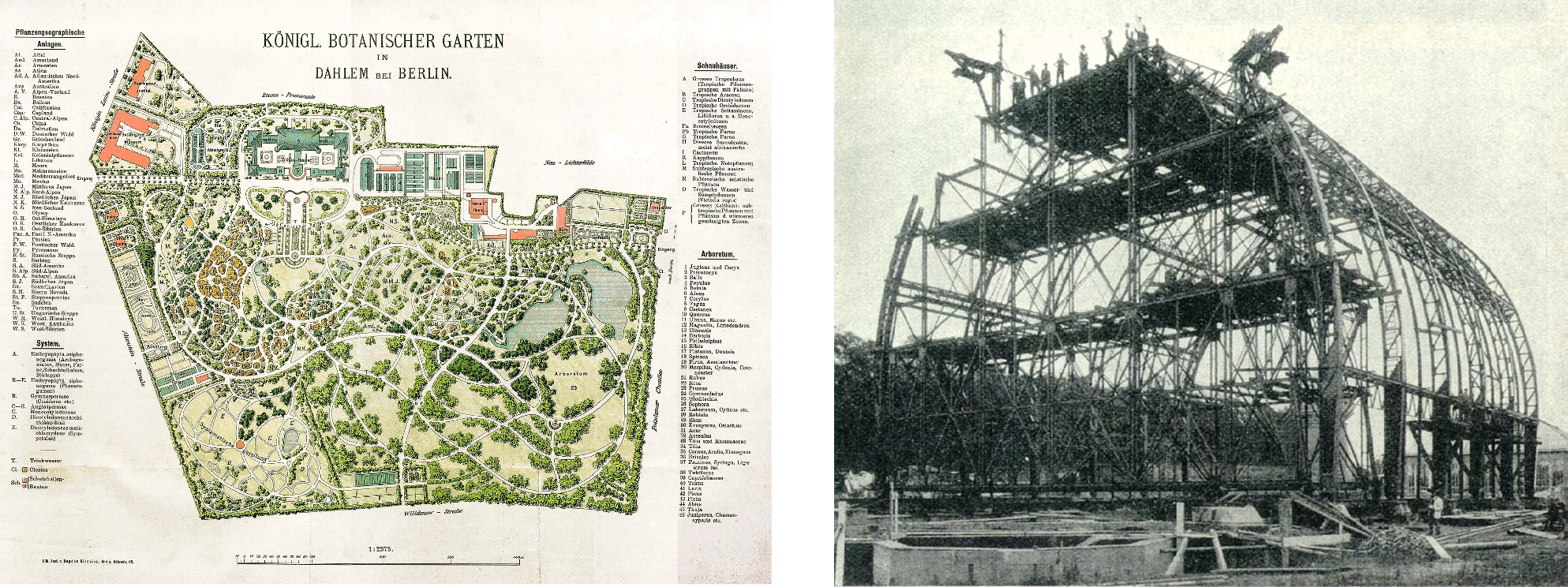
The garden is an invaluable source of plant matter for morphology studies—what we do is we break them into anatomical parts, fix them still as they are and dry them out, get them under the microscope—bounce electrons off their contours, or slice them very thin and stain the cell walls to see the cross-sections inside. We look for patterns, relationships. In essence, this is a truly classic kind of botany, the collect-fix-stain-see procedure, twice as old as the grand late-colonial garden itself1, though supplemented nowadays with vitally modern genomics data, HQ digital photos and models, globally-circulated taxonomies. So down the stairs and out the door and into the botanical garden and the little chill outside wouldn’t bother us long, because the four of us Scientists were headed for the greenhouses. We looked more the part than we usually did inside, our band traipsing the paths decked out in so-official vests. In the lab, the white coats mostly hang to gather dust, and everyone working looks dropped in off the street.

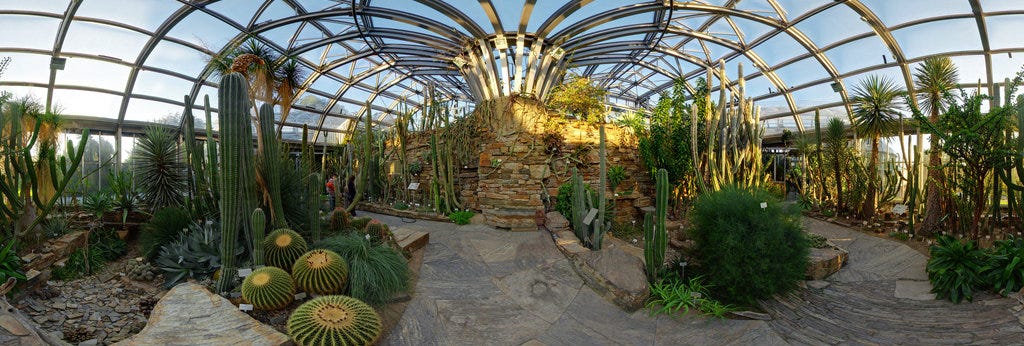
Inside, it was warm and planty and it smelled like wet stone and endless endless leaves. Vines towered, water dripped. Footsteps echoed, only a few; there weren’t many people around. Still, curious looks came when L set the bucket down on the slick floor and got a gloved hand under one long jutting branching stem of the first plant, cradling it. A man paused nearby, apparently stopping to observe a motionless leaf, his eyes of course sliding now and then to our group, to us Scientists.
There was low talking between L and B, a rapid consensus on the age and life stage of the buds. And then L crouched low to get a hand into the bucket and back up she came pinching a razor blade and it rose to the base of the bud. She held it there, positioning, pressing. Then a slice and it was over. Three buds hit the bottom of a tube, pat pat pat. The man stared.
It was in a big muggy room deeper into the greenhouse that we crossed paths with a date, good-looking people holding hands, admiring the life-forms. It was sweet, picturesque, the smiling and the laughing, the soft talking and the looking all around, at soaring vines and tropical flowers. Then us, gathered for the slicing and hacking of plant matter from the body, bizarre background figures.
“This probably looks so weird,” I whispered to J. The couple was about to pass our party. The smiles faltered, eyes on us. They took the long way round. I pinned my gaze to the new tube—pat, another bud—and smoothed my vest.
“I know,” J whispered back.
What were we to these people? Half an hour ago, we’d been hanging out in the office, looking like anyone. Now green-vested drones, machinery, exposed pipes, nameless and official, clearly employed or sanctioned by the greenhouse with the vests and the cutting of the look-don’t-touch curated plants, maybe carrying out an important service, important garden business, surveying the plants for growth, for health, it could be. How to construct a model of our group, of our work, through onlooker eyes? What speculations drove the little wary looks and the respectful distancing? Was something wrong with the plants?, I imagined them thinking, or was this a routine thing, something of the hidden workings of the up-to-now museum-like greenhouse display?2 How important could this thing be, for a party of four in uniform to gather round for what was at a glance a one-person job—pinch, cut, catch? Could there be a vegetable infection at hand, and should a person stand clear so as not to breathe it in? What in the end should bring Scientists in during visiting hours to band around looking so serious and scrutinizing?
Come to think of it didn’t this whole thing look pretty artificial when you saw the drones—like something from an alien planet, all the towering cacti and the grasses and aloes and the vivid pinks packed into a big glass box in Berlin, labelled neatly? It was something like a lab itself.
Out of the greenhouse, on the dusty path back to the lab, J and I broke off to walk behind B and L.
It was simple student work, that was all, and half those professionally-collected buds could end up pickling in the fridge all year, or come apart in shreds in the hands of some undergrad with a carefree sectioning technique, and B was just supervising and J and I were just tagging along and trying our best to look undistracted, and any later in the day and I’d have to get to my seminar, and any earlier and J’d have been late. This is what scientists look like, and science always hides science3; if any of it came to words, the plant matter, a publication sure wouldn’t say anything about our wet shoe-soles from greenhouse puddles, the odd looks coming our way from the date unfolding parallel to our solemn official sample collection, the un-romantic invasion by our mysterious labour of the pretty passive plant display which until then, until us, maybe could just as well have been as it was, untouched and natural, forever.
Up ahead, we watched the sample bucket swing in L’s hand, and laughed and talked fast and probably looked more than anything like chatty young people, out walking, going somewhere.
See Die Grundzüge der Wissenschaftlichen Botanik (Principles of Scientific Botany), a seminal text in modern botany by onetime Berlin transplant and noted cell theory pioneer Matthias Schleiden.
You are at the Louvre and you watch as a uniformed party of Gallery Officials swabs the surface of the Mona Lisa. How does it change the atmosphere? How does it change the art?
See Latour, Circulating Reference.